
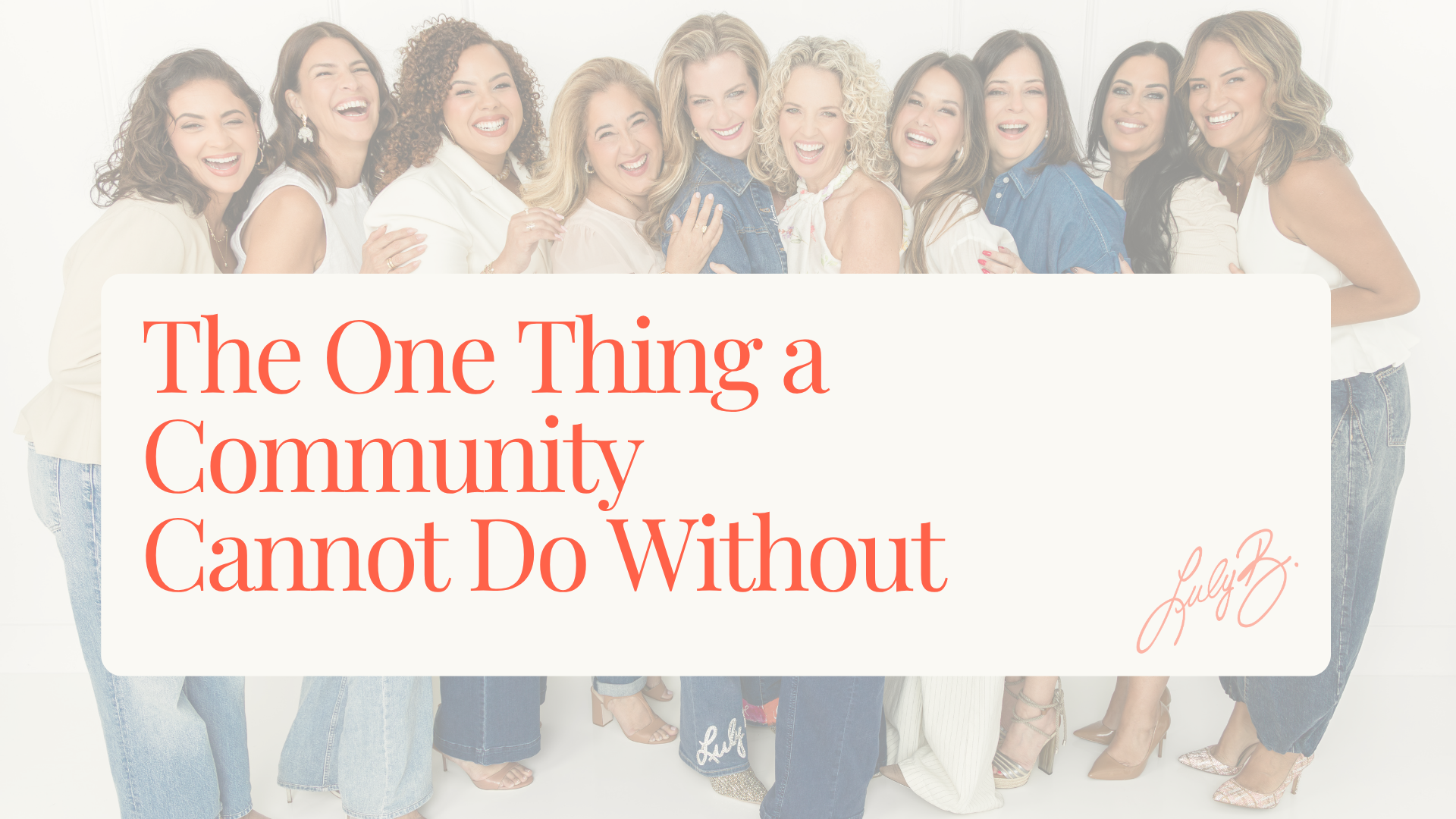
The One Thing a Community Cannot Do Without
"Community" is everywhere right now. And it has become a word we use without discretion.
There are groups for every stage of your life and your business, every stage of your marriage and your child's milestones. You can find circles for personal and professional development, networking and hobbies, too. We've started calling all of it "community," when most of it is actually a membership or a network, and I think it's important to make the distinction.
I was able to name the distinction recently when I heard Dr. Lisa Harper preach on the "one another" instructions woven all through the New Testament. Love one another. Encourage one another. Forgive one another. Carry one another's burdens. The phrase shows up 59 times and serves as instruction for anyone who wants to live in real relationship with other people.
Is that really a community or something else?
"Community" is everywhere right now. And it has become a word we use without discretion.
There are groups for every stage of your life and your business, every stage of your marriage and your child's milestones. You can find circles for personal and professional development, networking and hobbies, too. We've started calling all of it "community," when most of it is actually a membership or a network, and I think it's important to make the distinction.
I was able to name the distinction recently when I heard Dr. Lisa Harper preach on the "one another" instructions woven all through the New Testament. Love one another. Encourage one another. Forgive one another. Carry one another's burdens. The phrase shows up 59 times and serves as instruction for anyone who wants to live in real relationship with other people.
This instruction isn't just in the Bible. The African philosophy, Ubuntu, says it as "I am because we are." Buddhism holds up the sangha, the community itself, as one of its three treasures. The Stoics had a word, sympatheia, for the idea that all of us are threads in one connected whole. And Brené Brown's research keeps landing in the same place, that we are wired for belonging and connection is a need, not a nice-to-have. While these instructions were given in different centuries, different continents, and different customs and ways of life, the same instruction lives underneath all of it. Take care of “one another.”
A network exists for reach. You're there for the referrals, the introductions, the room full of people who might one day send business your way. That's good. That's what it's for. A membership exists for a benefit. You pay, you get access, you get the perk or the classes or the content. Also good. Also exactly what it's for. And if you notice, both of those answer the very same question. What can I get out of this? That is not a criticism, simply the honest transaction at the center of a membership and a network, and there is nothing wrong with it.
And any of these can become a community. I have seen it happen in networking groups, in gyms, in paid rooms of every kind. But it was never the thing being sold. It grew because the people inside it started answering a different question than the one they came in with.
A community answers a completely different question. Not what can I get, but what can I bring.
For over eleven years in the BOOST community, I have watched women live that out. They get the planning workshops, the strategy sessions, the masterminds, the accountability, the co-working. All of that is real and all of it is valuable, and none of it is what makes BOOST what it is. Those things are the container. The "one another" is the heartbeat. The ones who thrive here are not the ones auditing what they get for their money. They are the ones who walked in ready to give.
I have seen a woman say out loud in her first week as a member that she needed a home for herself and her two daughters as she experienced divorce, and she had one within 72 hours, because a realtor in our community heard her and moved. I have seen more than a dozen women show up to a member's father's funeral Mass, most of whom had never met the man, because they knew her and that was enough. I have watched members quietly remake a widow's bedroom so she would not have to walk back into the room the way she left it.
Not one of those women was assigned. Nobody was following a program or checking a box. They showed up because that is what the space inspires you to do. You cannot buy that. It is not a tier or a perk in the welcome packet. It is what grows when a group of people has practiced showing up for "one another" before the crisis or the victory or the obstacle or the launch.
So before you call the next thing a community, let's get clear.
Some of it is the messaging. Groups get sold as community when what is actually being offered is a membership or a network, and people walk in expecting one thing and receive another. That is misleading and it deserves to be named.
If you are the leader, the responsibility to name it correctly is yours. Do not borrow the warmer word because it sells better. Say what this is, and then demonstrate it, because people learn what a space is by watching how the person leading it behaves. A community is always a reflection of its leader.
If you are the member, sometimes you were looking for community and you bought a membership. The thing delivered exactly what it promised, and you were disappointed anyway, because you came hoping for something that was never on the shelf. So ask yourself two honest questions. What are you actually looking for? Belonging or a benefit? Both are legitimate. They are just not the same purchase. And how do you plan on showing up once you are there? Will you bring anything nobody asked you for?
If what you truly want is community, the way in is simple. Quit asking what you'll get, and go be the "one another" for somebody. Carry the burden, send the note, show up to the thing. That is all it has ever taken.
What's Proper Can Cost You What Matters
When I was a girl, I couldn't climb a fence without a little help.
You know the one. Too tall to climb on your own, standing between you and wherever the fun was happening on the other side. And there was always that moment where you looked at your friend, and without a single word exchanged, they cupped their hands together, braced their shoulder against the wood, and said, "Come on, I've got you."
You put your foot in their hands. They pushed. And up you went.
No hesitation. No negotiation. No "let me check if this is the proper way to get over a fence." Just a boost. One person lowering themselves so another could rise.
I've spent years teaching women that this is not something we outgrow. That the boost is available to us in business and in life, that we are allowed to ask for it, and that we are allowed to receive it. But this season of my life reminded me of something I don't say often enough:
Sometimes the boost comes even when you forget to ask. And sometimes the only thing standing between you and receiving it is your own idea of what's "proper."
When I was a girl, I couldn't climb a fence without a little help.
You know the one. Too tall to climb on your own, standing between you and wherever the fun was happening on the other side. And there was always that moment where you looked at your friend, and without a single word exchanged, they cupped their hands together, braced their shoulder against the wood, and said, "Come on, I've got you."
You put your foot in their hands. They pushed. And up you went.
No hesitation. No negotiation. No "let me check if this is the proper way to get over a fence." Just a boost. One person lowering themselves so another could rise.
I've spent years teaching women that this is not something we outgrow. That the boost is available to us in business and in life, that we are allowed to ask for it, and that we are allowed to receive it.
But this season of my life reminded me of something I don't say often enough: Sometimes the boost comes even when you forget to ask. And sometimes the only thing standing between you and receiving it is your own idea of what's "proper."
The call I almost talked myself out of
My husband, Gino, recently returned to his homeland of Togo, in West Africa. He went to bury his mother. He spent twelve days there, honoring her, celebrating her life, sitting in the particular kind of grief that only comes when you lose the woman who first taught you how to love.
A few days after receiving the news, a dear friend of mine called. I will never forget her words, because she said them plainly, without a trace of hesitation: "I want Gino to feel loved and supported by us. How can we do this? What is the proper way to honor his customs and traditions and also make him feel as special as he is?"
I am embarrassed to say, but I shrugged it off.
I dismissed it, kindly but firmly. You see, in West African tradition, when you attend a funeral, you give money. It is an act of respect, of shared burden, of community. But here, in the culture I move through every day, handing someone an envelope of cash after a death can feel awkward. Improper. Something people might raise an eyebrow at.
So in a split second, I made her beautiful question about me. About logistics. About what would look right and what people might think. I told her that when Gino returned, we'd hold a mass and some kind of celebration of life, and that I'd get back to her later about what our "boost" should look like.
I took her open hands, ready to lift us over the fence, and I said, "Not yet. Let me first make sure we're doing this the right way."
She had other plans
Thank God she didn't listen to me.
My friend went quietly, without permission. She and another friend sat down and did the work. They researched the customs and traditions of West Africa so they could honor Gino in a way that was aligned and respectful, not assumed. They learned what mattered in his culture rather than defaulting to what was comfortable in ours.
And then they gathered the community. They collected from our prayer group. From my clients, family, and our closest friends. People who love Gino, quietly folding their support together into one gesture.
When they presented us with that gift, it brought us to tears. Full stop.
Not because of the amount (although that took our breath away as well!). Because of what it meant. He felt seen. He felt held. And we felt loved in a language my husband's heart recognized without translation. It aligned perfectly with his customs and traditions, the very thing I had been so worried about getting "right" that I nearly did nothing at all.
She got it right precisely because she refused to let "proper" become an excuse to stay small.
What I almost missed
I nearly robbed my own husband of one of the most meaningful gestures of his grief because I was worried about how it would look. I made it about propriety when it was always supposed to be about love. I stood at the fence, and instead of putting my foot in my friend's hands, I started giving a lecture on the correct technique for climbing.
How often do we do this?
Someone offers to help, and we say, "Oh no, I couldn't." Someone tries to show up for us, and we manage them, we shrink the gesture, we make it convenient and tidy and small. We turn a moment of connection into a logistics problem. We let "the right way" become the enemy of the loving way.
And it's not just when we're receiving. We do it when we're giving, too. We hesitate to show up for someone because we're not sure of the etiquette. We don't send the meal, make the call, or gather the group because we're afraid of doing it wrong. So we do nothing, and we call our inaction "respect."
But love was never asking for perfect protocol. Love was asking for our hands.
The invitation
So here is what I want to leave you with, whether you run a company, a household, a classroom, or simply a life you're trying to live with meaning.
Can we make it about what matters instead of what's proper?
When someone offers you a boost, take it. Stop auditing whether it's proper, whether the timing is right, whether you've earned it, or whether people might raise an eyebrow. Those questions keep us stuck at the fence. The "how" is not the point. The love behind it is.
And when you are the one with cupped hands, resist the urge to get the method perfect before you move. You don't need the flawless approach or the socially correct gesture. You need to know what actually matters to the person in front of you, and then act. That's what my friend understood. She didn't ask whether it was polite. She asked what would make him feel loved, and let that answer lead.
Because at the end of the day, the goal was never to do it properly. The goal was to make someone feel loved and supported. And when we let go of everything else and let that be the goal, that is exactly what happens.
To the friend who went behind my back, the amazing, generous and super special Dr. Betsy Guerra: thank you for climbing the fence when I was too busy studying it. You didn't just help us over the fence. You reminded me that when we focus on what really matters, everything else gets out of the way.
The Gifts Hiding in a Slow Summer
Summer has a reputation for being the season business goes quiet, and most of us treat that quiet like something to wait out. We tell ourselves everyone is on vacation, so we ease off and wait for September to bring everyone back.
But everyone is not actually on vacation. And because we have all decided that "nothing happens in the summer," almost nobody is doing the work. The calls are not being made. The follow-ups are not being sent. The relationships are not being tended. Which means the lane is wide open for the woman who decides to show up while everyone else is sitting it out.
So what if the slowdown is not the problem to survive, but instead the time the busy season never hands you? A quieter calendar is not always a sign that something is wrong. It can be a window. The very things you never have time for when you are running full speed are suddenly sitting right in front of you, waiting. The only question is whether you use the time or let it slip past while you wait for fall.
So here are some ideas for what you can do with yours.
Reconnect with your people.
When the calendar finally opens up, you have the rarest gift in business, which is time. Time to make the call and actually stay on the phone. Time to book the coffee, schedule the dinner with your top clients, and connect the people in your world who should know each other. These are the small gestures the rush doesn't always allow.
This is also the season to reach back. Pull up the client who went quiet six months ago and send a genuine note, no pitch attached, just letting her know you were thinking of her. Record a quick video message for a top client instead of another email, and watch how differently it lands. Ask three of your best clients what is working for them and what they wish they had more of, because that conversation is market research and relationship building in one.
Write the actual handwritten card. Introduce two people in your network who should already know each other and ask for nothing in return. Check in with the vendors and partners who make your business run, not because you need something, but because the relationship deserves tending when you are not in a crunch. This is your safety net and your growth engine at the same time.
Curating your relationships is the work that moves the needle most, and summer is when you finally have the hands free to do more of it. Leverage it!
Clean it up.
You know the pile. The files you keep meaning to sort. The space that has gotten heavy and cluttered. The tired system you have been duct-taping together for two years because you never had a quiet afternoon to fix it properly. Clearing the clutter is the act of making room for what comes next.
So go wider than the desk. Clean out the inbox and the contact list, and finally archive the leads that were never going anywhere so your pipeline reflects reality instead of wishful thinking. Refresh the things clients actually see, your website copy, your headshot, the bio that still describes a version of your business from three years ago. Revisit your pricing and your packages with honest eyes, because the rush is never the time to raise a rate or retire an offer that no longer serves you. Audit every subscription and tool you are paying for and cancel the ones you forgot you had. Document the process you rebuild from scratch every single time, so future you is not starting over again.
When you tidy the back end of your business and the spaces you work in now, you head into your busy season clear, light, and ready for what is next. You cannot welcome new opportunity into a space that is already overflowing.
Invest in you.
That bookmarked course. That dusty book on your nightstand. The podcast you keep meaning to start. The skill you have been telling yourself you will sharpen the second things slow down. Well, things slowed down. This is the season to pour back into the one asset every part of your business runs on, which is you.
So now’s the time to pick something and actually begin. Take the course and do the work inside it instead of letting it sit in a tab. Learn the tool you keep hearing about, whether that is a new system, a way to use AI in your business, or the software you have been avoiding. Go to the workshop, the conference, or the local event you always skip because you are too busy. Find the mentor or coach who has done the thing you are trying to do, and ask for the conversation. Spend an afternoon with your numbers and your vision so you walk into fall knowing where you are actually headed, not just reacting to it.
And do not skip the quieter kind of investment: the rest, the long walk, the time to think. Because a depleted founder makes worse decisions no matter how full her calendar is. Growth does not stop just because revenue does.
Here is what I know after years of watching women move through these quiet stretches. The ones who come out of summer ahead are never the ones who waited for it to be over. They are the ones who looked at the open space on the calendar and decided to use it on purpose.
When fall arrives and the calendar fills back up, what will you be glad you did with this quiet stretch? Answer that now, while you still have the time to do something about it. Trust that the quiet was given to you for a reason, and use it like the gift it is. What you plant in this season is exactly what you will be standing in come fall.
What Working From Home Taught Me About Boundaries, Connection, and What Matters
I have been working from home for more than a decade now, long before Zoom fatigue had a name and long before everybody started arguing about remote versus in office like it was something we all had to vote on. From the outside it looked like the dream. I had the freedom to build my business on my own terms and in my own space, and most days I was genuinely grateful for it.
What I didn’t expect was how working from home would teach me two of the biggest lessons not just of my career but of my whole life. One was about boundaries, the other about community, and both were harder to learn than they looked from the outside.
In the beginning I was distracted by everything that was not actually my job. The dishes in the sink waved at me every time I walked into the kitchen, the laundry called my name from down the hall, and there was always something in the house asking to be handled right that second. Because I was physically home, I convinced myself I should be able to do all of it at once, running the business and running the household in the same breath, like some kind of superhero with a laptop in one hand and a sponge in the other.
It took me far too long to realize I had built an expectation for myself that not one single person had asked me to meet. If my office had been across town, nobody would have expected me to drive home at noon to wipe down the counters or wondered whether I had folded the towels between meetings. But because my office happened to live inside my house, I decided I should somehow be pulling off both jobs at the same time.
Eventually I had to ask myself the same question I ask everybody else who sits across from me. Is this your reason, or is this your excuse?
That question changed how I saw myself. I was no longer a woman who happened to be home; I was a woman who was at work, and my days reshaped themselves around that one distinction. I gave myself a real workspace and real working hours, and I stopped measuring my worth by the chores I could knock out between appointments. The way you do life is the way you do business, and if you let everything interrupt you at home, you can count on everything interrupting your work too.
The boundaries, though, were only half the story. Once I finally learned how to protect my focus, a different problem showed up at my door, which was that I was alone. We love to talk about the perks of working from home, the freedom and yes, even the yoga pants, but we rarely talk about what happens when a whole week slips by and nearly every conversation you had came through a screen. Nobody warns you about the quiet, sneaky weight of isolation, or about how easily you can drift away from the very people who help you think bigger and call out the excuses you cannot always see on your own.
I knew myself well enough to know that being alone was never going to serve me. As much as I love the freedom of working from home, my creativity and my energy have always run on connection, and my best ideas have almost never arrived while I was sitting by myself in my office. They come out of real conversations, out of being in a room with women who see the world differently than I do.
So I made a decision that if working from home was going to last, I could not leave connection up to chance. I started designing my weeks with the same intention I bring to my business strategy, scheduling the coffee meetings I used to push off and making a point of sitting across the table from clients and fellow business owners in person whenever I could. Connection stopped being the little treat I would get to if there was time left over and became part of the actual work, because that is exactly what it is.
What a decade of this has taught me is that the hardest part of working from home was never managing my calendar. It was managing the tug of war between responsibility and connection. One side of you insists there is always more to do, more work and more obligations stacking up at the door, while the other reminds you that success means very little if you end up building the whole thing alone. The answer was never about choosing one and abandoning the other. It was about building a life that honors both, with boundaries that let me focus on the work that matters and community that reminds me why the work matters in the first place.
Years ago I wrote a book called BALANCE IS BULL$H!T, because I was tired of watching women get sold a fairy tale about what work and life were supposed to look like, and I still believe every word of it. Balance was never the real goal. Intentionality is, and what has carried me through the last ten years is not some perfect system but the deliberate choices I keep making about where my attention belongs and who belongs in my life. A business and a life of real significance do not come from doing everything. They come from focusing on what matters most and surrounding yourself with the people who help you become the woman you were created to be, and that stays just as true whether your office is in a corporate building or down the hall from a sink full of dishes.
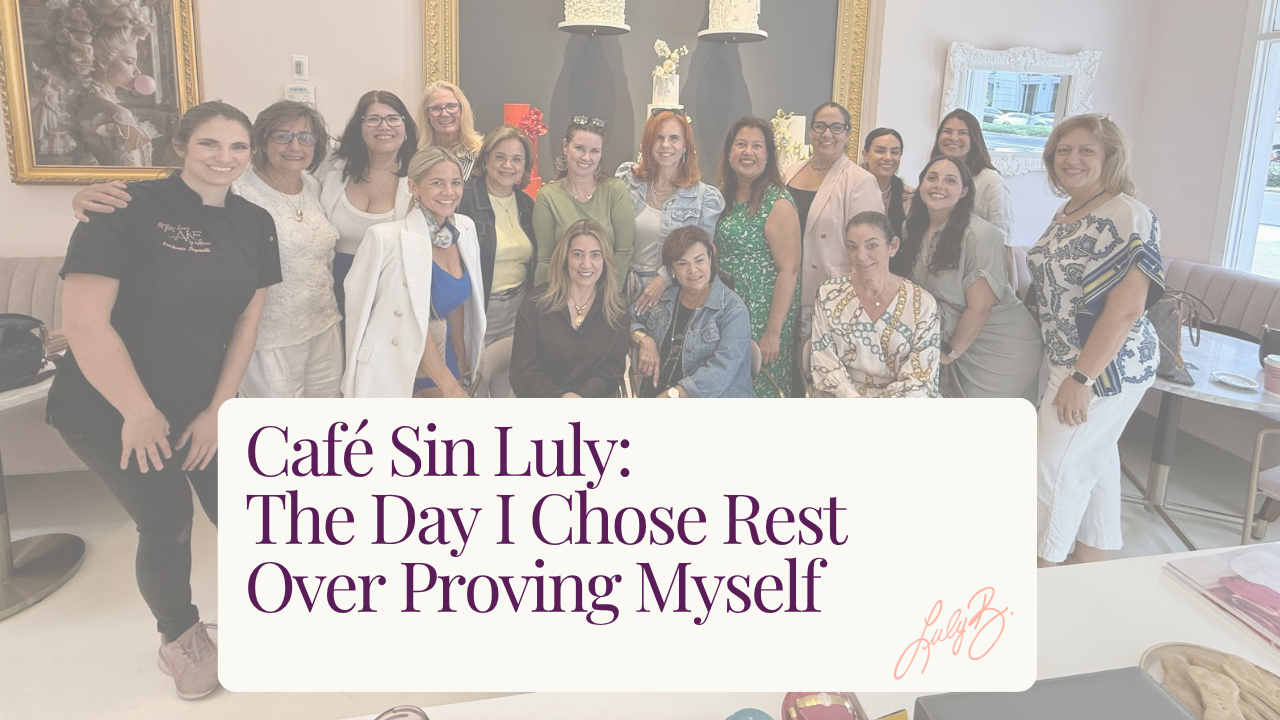
Café Sin Luly: The Day I Chose Rest Over Proving Myself
Last week, I had pneumonia. And for the first time in a very long time, I made the decision not to push through.
The event called Café con Luly (Coffee with Luly) happened without me there to host it. It was, quite literally, Café sin Luly (Coffee without Luly). Instead, three BOOSTIES (members of my BOOST community of women business owners) stepped in and led the morning beautifully. I requested their support, then prepared them, and supported them behind the scenes. I followed up with attendees afterward, and made sure the experience remained intentional and impactful. But physically, I was not in the room.
The event was still amazing. The conversations still happened. Women still connected. The energy, encouragement, and sense of community were all still there. Nothing fell apart because I wasn’t there holding every piece together. And that has stayed with me all week.
Fifteen years ago, I wrote a book titled “Balance is Bull$!t.” At the time, I was speaking to the impossible standards women were trying to live up to while juggling careers, motherhood, relationships, responsibilities, and the pressure to somehow do it all flawlessly. As a young mom, a devoted wife and someone who absolutely loved her career, I found myself angry with the advice I received often to “just balance.”
And while I still believe “balance” is often an unrealistic expectation for women leading full lives, I’ve come to understand something even more important over the years. There’s a difference between being committed and being consumed.
So many professional women are carrying invisible weight. Whether you’re a business owner, a CEO, a community leader, or leading a division inside a corporation, there is often this unspoken expectation that you must always be available, always capable, always “on.”
You become the problem solver, the emotional support system, the decision-maker, the dependable one. Before we know it, so many of us begin tying our value to how much we can carry and how much we can endure.
I know that mentality well because for years, I lived it.
The old version of me would have absolutely shown up sick. Hair done. Lipstick on. Smiling through the exhaustion while privately running on fumes. And people probably would have applauded my dedication. They would have called me committed. Reliable. Devoted. Strong.
But receiving the videos and photos from the event and still hearing “Café con Luly was so great!” hit me deeply. It reminded me there is no reward for self-abandonment. No prize for ignoring your body. No trophy waiting for the woman who proves she can carry everything at the expense of herself.
For so many high-achieving women, leadership quietly becomes performance. We convince ourselves that being valuable means being constantly available, constantly needed, constantly holding everything together.
And last week, I proved that being valuable means something completely different from what so many of us believe. I trusted the women I’ve invested in. I allowed community to do what community is designed to do. And in the process, I reminded others that healthy leadership is not about becoming indispensable. It’s about building people and relationships strong enough to continue thriving even when you need to step away for a moment.
For years, I unconsciously believed my presence was the glue. But maybe real leadership is creating spaces where other people feel empowered enough to lead too. Maybe the goal is not to build businesses, communities, or teams that collapse without us. Maybe the goal is to build something healthy enough to continue flourishing even when we pause.
That requires a different kind of strength. The kind rooted in discernment. Knowing when to lead from the front and when to step back. Knowing when to push and when to pause. Knowing when your body is asking for care instead of pressure.
This matters because so many women are over-functioning right now. We are managing households, businesses, teams, aging parents, children, marriages, expectations, and endless responsibilities while quietly convincing ourselves that depletion is simply the price of ambition.
I don’t believe women need to destroy themselves to prove they are committed. I don’t believe suffering in silence makes us stronger. And I certainly don’t believe exhaustion is proof of excellence. In many ways, staying home last week was one of the healthiest leadership decisions I’ve made in years. Not because I avoided responsibility, but because I honored myself while still honoring the mission.
Sometimes the most powerful thing a leader can do is trust what she has built. And sometimes the most powerful thing a woman can do is rest.
The most radical Valentine’s gift is now available
Valentine’s Day can often make us feel like we need to give more, love more, do more, show up more.
What if we flipped the script?
What if the most radical form of LOVE isn’t another act of service, but the willingness to receive love first?
I know what you’re thinking. “Receive? You mean just let someone else do for me? Sit back, take up space, maybe even need something?”
YES, that is totally what I am suggesting…
Valentine’s Day can often make us feel like we need to give more, love more, do more, show up more.
What if we flipped the script?
What if the most radical form of LOVE isn’t another act of service, but the willingness to receive love first?
I know what you’re thinking. “Receive? You mean just let someone else do for me? Sit back, take up space, maybe even need something?”
YES, that is totally what I am suggesting…
Last week, I shared something raw, honest, and deeply personal about receiving as radical leadership. The response took my breath away. The messages, the reflections, the quiet “this is exactly what I needed” notes reminded me why community, connection, and truth-telling matter so deeply.
As we head into a long weekend where romantic love takes center stage, I wonder if we can begin to see receiving as an act of love, especially for the woman who "does it all."
You know the woman I’m talking about. The “I can handle it” woman. She believes that asking for help is a sign of weakness and that receiving somehow burdens others. Independence becomes her badge of honor, and “doing it all” becomes proof that she’s capable, strong, and worthy. I know her well. I was her. For a long time, self‑reliance was my armor. While polished and protective, it was slowly suffocating. It kept me safe from needing anyone.
But things have changed since then. Drastically so.
Today, I actually love to receive, and I have gotten quite good at it. When someone makes an offer, I say yes. In fact, it has become a running joke that if you offer me anything, you go on “the list.” And soon, you’ll get a call to take you up on the offer! (I literally have that list in my Notes app to prove it!)
Here’s how we flip the script in this season of love: Receiving honors the giver and builds trust. Receiving keeps relationships alive instead of transactional. It isn’t passive. It’s intentional leadership. Receiving is radical leadership.
So here’s my question for you:
What is one thing you could allow yourself to receive right now? Help, rest, encouragement, clarity, or simply permission to pause?
Would love to hear how you will join me and celebrate Valentine’s Day by finally opening the gift of receiving.
Receiving is Radical Leadership.
Some seasons don’t just disrupt your life. They demand a different way of leading.
Today marks eight years since my life split cleanly into a before and an after. The night I discovered my husband of nearly twenty years having dinner with another woman. It was a moment that was both an ending and a new beginning. It marked the beginning of a season filled with so much pain that also inspired me to receive help, support, and unimaginable love that forever changed me and the way I choose to lead.
Some seasons don’t just disrupt your life. They demand a different way of leading.
Today marks eight years since my life split cleanly into a before and an after. The night I discovered my husband of nearly twenty years having dinner with another woman. It was a moment that was both an ending and a new beginning. It marked the beginning of a season filled with so much pain that also inspired me to receive help, support, and unimaginable love that forever changed me and the way I choose to lead.
It would be easy to get caught up in the details of that night. The questions people often ask. The parts that satisfy curiosity. But that’s not where the real story lives.
What mattered far more then, and still matters now, was what that moment would teach me about who I was, what I believed, and the kind of leader I wanted to be when everything I thought was stable suddenly wasn’t.
I was the girl who worked hard, sat in the front row of the class, took meticulous notes, and got the A. I believed that if I prepared enough, performed well enough, and did everything “right,” things would work out the way they were supposed to.
I had also built a career rooted in connection, relationships, and trust. My roles as a wife and mother were woven into my speaking, my training, and the way people understood my credibility.
Suddenly, I was faced with a fear I hadn’t named before.
That I might be disqualified.
That I might be exposed.
That I might no longer be trusted to lead conversations about life, work, and community.
What shattered wasn’t only my identity. It was the illusion that control equals safety. That certainty equals security. That doing everything right would somehow protect me from pain.
It didn’t.
In the days and months that followed, people had opinions. Lots of them.
They told me to fight.
To think about my kids.
To save my family.
And I did fight. Just not the way people expected.
I chose to fight for my peace.
I chose to fight for my integrity.
I chose to fight with grace and in a way that I could be proud of years later.
That choice didn’t come from nowhere. I had training as a coach. Over a decade of experience in self-development. A strong faith foundation I could lean into when the ground beneath me felt unsteady. And dozens of people ready to support me with any request I might have.
So instead of spiraling, I focused on doing the next right thing.
One decision at a time.
One day at a time.
One breath at a time.
It was so hard.
What I didn’t realize then was that I trusted myself enough to reach for support immediately and that choice saved me. I had always been the strong one. The capable one. The dependable one. The woman others leaned on. And without even realizing it, I had built a life around performing strength.
I focused on being strong, so no one worried about me. I over-functioned so I didn’t have to sit in uncertainty. I held emotional space for everyone else while quietly minimizing my own needs. I would stay busy so I didn’t have to feel what lived underneath the motion. I focused all my energy on leading, organizing, supporting, fixing… instead of receiving.
At the time, I called it resilience. What I didn’t see was how much of it was rooted in control. Control was my comfort zone. It always had been. It gave me a sense of safety. In the certainty it gave me, I felt protected. Staying in motion meant I didn’t have to sit with the not-knowing.
But eventually, that kind of strength becomes isolating. Not because you don’t have people around you. Often, you often have more people around you waiting for the chance to help than you can imagine. The isolation comes from not allowing yourself to be held by them.
And this is the part that still humbles me today. Community didn’t just support me during that season. Community saved me.
For nearly two decades, my work has centered on bringing women business owners together through connection, community, and shared opportunity. Out of that work grew a community built on giving each other the BOOST. Supporting one another. Opening doors. Sharing resources. Showing up consistently.
I didn’t realize how deeply I would need to live those principles until my own life demanded them. Requesting and receiving the boost saved me. And it was my very own community that I had founded just three years prior that showed up and showed up BIG.
Betsy called every morning at 8 a.m., without fail, because she also knew mornings were the hardest. She was on call far beyond that, listening to everything, at any hour. Inez stayed on standby for the 3 a.m. panic attacks, when the world felt especially dark. Eva showed up in the mornings with a cup of coffee and a gentle lie that she was already in the area, because she knew mornings were the hardest and I shouldn’t have to face them alone. Adriana co-worked beside me, holding quiet space while I sobbed, stared at my screen, and felt completely stuck. Angelique stayed on the phone with me as I lay on the bathroom floor, sobbing, just so I wouldn’t feel alone. Deanna and I spoke for hours at a time. Nicole ordered dinner for me and my boys on the nights when deciding what to eat felt impossible. Lina guided me in how to parent through grief and uncertainty, helping me hold space for my sons when I wasn’t sure how. Helen reminded me, again and again, that the divorce process is never about the stuff. Adrianna met me weekly for hypnotherapy, helping my nervous system find its footing. Gaby took me out and reminded me that joy and laughter were still allowed. Caro shared her own story and held space for me the night before a keynote in Cincinnati, when I needed courage. Sheena reminded me that I had the power to assign new meaning to everything that was happening. Mari and Monica insisted I tag along to a girls’ trip to Sedona.
Each day, I requested.
Each day, I received.
Each day, I focused on grace and the love that was being poured into me.
Each day, I became a different type of leader.
The truth is that receiving is radical leadership. When you refuse help, you don’t just deprive yourself. You deny someone else the opportunity to show up. And that is not only doing a disservice to you, but also a huge disservice to them.
When I got brave enough to say I wasn’t okay, became clear about what I needed, and allowed myself to receive, everything changed – for me and those who cared for me. And if it did for me, it will for you.
You might be the strong one. The capable one. The woman who juggles it all and rarely asks for help. You might be white-knuckling your way through a season because slowing down feels scarier than pushing through. You might be telling yourself you’re fine because it feels safer than being honest.
You probably are all those things and more. But too many capable, generous, high-performing women are leading everything and everyone around them, while quietly carrying far more than they should alone.
Leadership isn’t measured only by how much you can endure. It’s revealed by how you choose to sustain yourself.
Through this all, what I learned most is that receiving isn't a weakness, as my subconscious wanted me to believe. It’s discernment. It’s self-trust. It’s capacity. It’s allowing the community that I value endlessly to be reciprocal in nature – the way community has always been intended.
So let this be a gentle reminder: You get to be held too. And when you allow yourself to receive, you don’t lose your power. You keep it. You get to step into radical leadership.